Like many trainers and dog owners, Mike and I teach our pups early in life that quiet time and short periods of separation are associated with the offering of a special chew. This toy appears at the start of quiet time and is taken away once the separation is over (for specific details about this approach, see my book “Dog Smart“). Years ago at a training seminar, Jean Donaldson referred to these as safety cues, a moniker that aptly describes their intended use. Today, we consider these to be a particular category of enrichment for dogs.
There are a variety of approaches to enhancing a dog’s comfort while alone. Stuff-able bones and food-delivery toys of various forms are both high on this list. In our home, we have used a variety of approaches over the years. Currently, Kong bones stuffed with biscuits or frozen with soft food inside are a favorite.

What Does the Science Say? There are a few studies that have examined what dogs enjoy most in terms of enrichment. For example, one group of researchers examined the effects of food delivery toys on dogs’ activity levels, while another group compared food delivery toys to several non-food types of enrichment.
Recently, researchers with the Waltham Petcare Science Institute in the UK studied the attractiveness of chews versus food-delivery toys or devices when used as safety cues during periods of isolation. Specifically, they compared the effectiveness among several types of toys for helping a dog to settle and be comfortable when spending time alone. Their results may be helpful to trainers and owners when selecting appropriate toys to use for this type of enrichment.
The Study
Twenty healthy adult dogs were enrolled. A set of four different food enrichment devices were tested for their efficacy as calming agents during a short period of isolation. A cross-over experimental design was used, which means that each dog experienced each condition (type of food toy) in a randomized order. The isolation period was 20 minutes and took place in a familiar room. The four toys were: (1) Long-lasting Chew; (2) Kibble in Treat-Dispensing Toy (Kong); (3) Kibble automatically dispensed from a treat-dispensing device on 1-minute intervals that included a human voice recording; and (4) Kibble dispensed from the treat-dispensing device on 1-minute intervals without the voice recording.
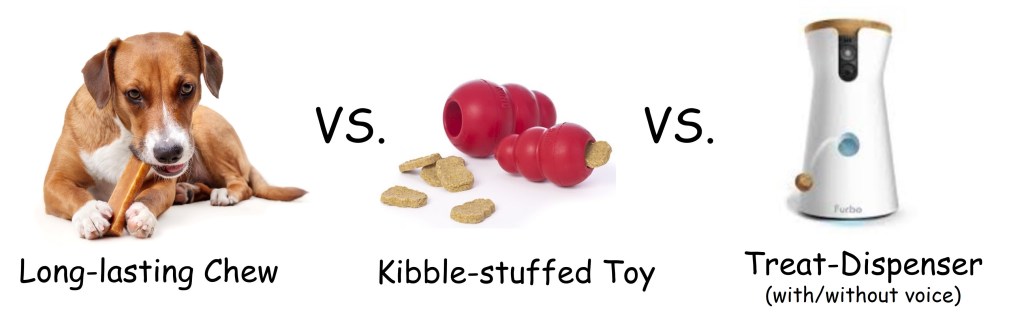
For each test, the dog was provided access to the chew, toy or treat-dispenser and then left alone in the designated room. Sessions were monitored by a researcher and were video-taped. The time that the dog interacted with the item, types/durations of behaviors, and signs of arousal or stress were identified and recorded.
Results
Overall, the dogs did not show extreme signs of distress (i.e. pacing, vocalizing, restlessness) and so were likely not experiencing severe separation stress. Several statistically significant differences among the four types of enrichment were reported:
- Lowest Signs of Stress/Anxiety: When provided with the long-lasting chew, dogs spent the largest proportion of time engaged with the toy and had significantly lower stress/anxiety scores and were rated as having the most positive emotional response (low arousal) when compared with the other toys.
- Highest Arousal/Activity: The automatic food-dispensing device caused the highest degree of arousal and activity. If food became inaccessible from the device, dogs’ emotional states became neutral or in some cases, negative (i.e. frustration). In addition, a relatively high proportion of dogs failed to ever engage with the dispensing toy during the isolation period. Interestingly, the voice recording did not influence the dogs’ behaviors.
- Kibble-Stuffed Toy: The kibble-stuffed Kong was associated with higher degrees of activity (arousal) and interaction during the first 10 minutes of isolation. This was not surprising given that movement of the toy was needed to dispense treats.
- Frustration Events: In more than half (58 %) of the isolation periods with the kibble-stuffed toy (kong), the toy became lodged under furniture, making it difficult for the dog to continue to play. In other cases, the toy quickly emptied of food. Negative emotional states (frustration?) were recorded in these instances.

Take Away for Dog Folks
This is the first published study that that has compared the efficacy of different enrichment tools when used as safety cues for dogs during periods of isolation. It is important to note that this is a specific category of enrichment that has usefulness both for teaching dogs to be comfortable while alone and for counter-conditioning mild forms of separation stress.
The results suggest that providing a toy or chew that encourages long-lasting and quiet engagement serves well as a safety cue for dogs when they are spending time alone. In this study, dogs were more likely to show low arousal and low stress (and lower activity) when engaged with the chew than with the other three conditions. The chew appeared to have some benefits over the wobbly stuffed Kong, which is a commonly used type of safety cue. These advantages may have occurred because the food-delivery toy required active manipulation to make it move, tended to become stuck and inaccessible, and in some instances, ran out of food – all conditions that may increase a dog’s degree of arousal and frustration.
By comparison, the electronic device, which simply dispensed a kibble at 1-minute intervals but required no direct interaction with the dog, failed rather miserably. The device had the highest ratings of stress responses during the first minutes of isolation, which is generally thought to be the most important period when dogs are left alone. During the second half of isolation, dogs tended to interact more with the device and were more active, possibly because they learned to anticipate the delivery of treats.
So, what can we do with this information? Well, for my dogs, it tells me that I should continue to use food-delivery toys such as stuffed bones (but not wobbly kongs or toys) as safety cues for my dogs. I will probably lean away from wobbly food delivery toys and most definitely am not going to try an automatic device (I have expressed my concerns about these devices in an earlier essay).
For all dog owners, an important consideration is whether or not something that you select for this purpose will engage your dog in a manner that is calming, rather than arousing. It is generally believed (though there is not much supporting research) that chewing can be calming for dogs. This study, though small (and with some limitations) suggests that providing something that allows dogs to quietly engage for a period of minutes, as opposed to actively manipulate or chase an object, (or simply be in the room with a treat-dispensing device), may be most calming.
Safety Concerns: One last important point is toy safety. Many types of chews, while highly attractive to dogs, have a risk of choking or gulping large pieces, especially once the chew has been partially consumed. The authors of the paper note that the manufacturer of the chew that was used recommended that dogs should be supervised when given the chew. For this reason, it is important to only select safety cue toys that are known to be safe for your dog. For example, a stuffed bone that contains small food bits, kibble, or frozen food may be preferable over an actual chew, if you have a dog who is an aggressive chewer or who tends to be a food-gulper.

Do you use a safety cue with your dog(s) during alone-time? If so, what do you use, why, and what are your experiences with this?
Tell us in the comments below!
Cited Study: Flint HE, Atkinson M, Lust J, Hunt A, King T. Long-lasting chews elicit positive emotional states in dogs during short periods of social isolation. Animals 13.4 (2023): 552.

Study with Us at The Science Dog Courses!
Completely on-line and on-demand courses and webinars for dog owners and pet professionals.
Two Masters Class Certificate Programs!

 The Science Dog
So what is a safe, long-lasting chew?
LikeLike
I often think that the dog should first know how to enjoy the chew, and to have lots of positive experiences with it when the owner is nearby or present, before it becomes associated or paired with isolation or departure. Thoughts on that?
LikeLike
Pingback: How Do Dogs Prefer to be Fed? | The Science Dog
The long lasting chew or food toy was already a trigger for my dog that I would leave so she tressed upon presenting it. I had to come up with a solution to teach her being relaxed while I leave (e.g. stressful trigger followed by something good) and I opted for the combination of a remote feeder, that I trigger while leaving and fade out after I have left and then she has to find a chew in the house. After the chew, she goes back to her bed to chill, the remote feeder presents no high arousal. Ideally the feeder will be faded out completely, however we are not there yet.
LikeLiked by 1 person